If you make handmade goods, jewellery, prints or digital designs, two places probably come to mind: Etsy and Instagram. Both let you reach customers online, but they work in opposite ways. Etsy is a marketplace where buyers come to search. Instagram is a place where your own followers find you.
For an Indian seller, the differences are bigger than they look, because Etsy has specific rules for sellers in India. This guide compares the two and explains when each makes sense. The Etsy details below come from Etsy and from several 2026 guides for Indian sellers, and Etsy changes its rules often, so confirm them on Etsy’s own pages before you decide.
How the two work
Etsy is a marketplace known for handmade, vintage and craft items. You list products, and buyers find them through Etsy’s search and recommendations. You pay fees to Etsy, and Etsy handles the listing pages and the payment.
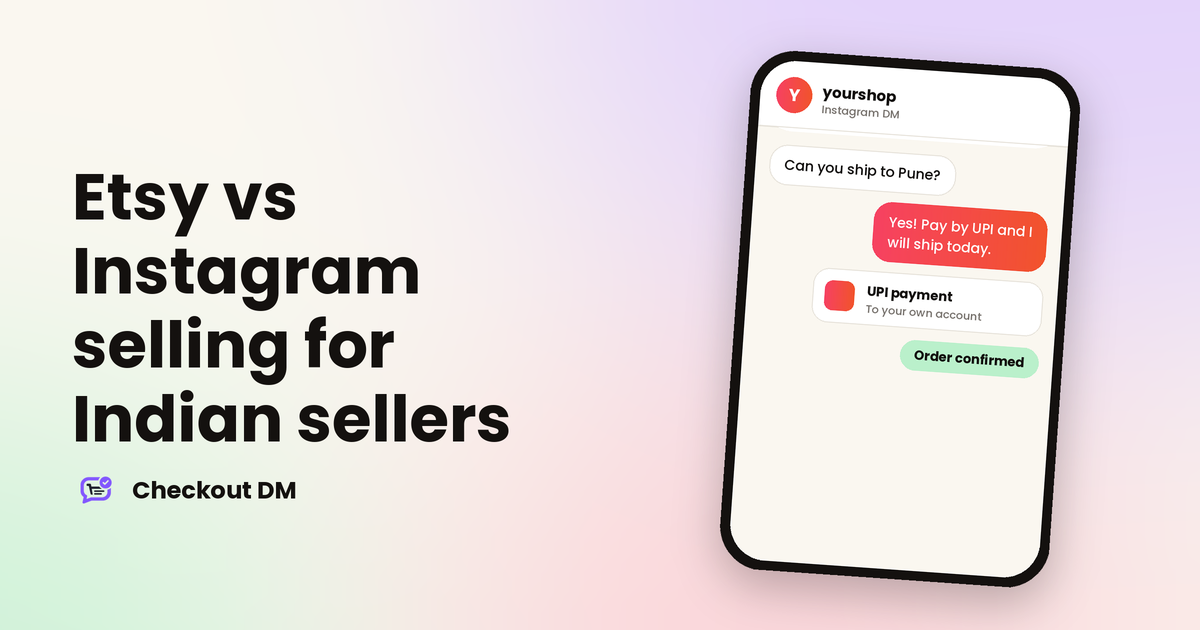
Selling on Instagram means building an audience with posts, Reels and Stories, and taking orders through DMs, comments and links. You do not pay a marketplace to find customers, but you have to attract them yourself. With a DM checkout tool such as Checkout DM, the order and payment happen right in the chat.
What Indian sellers need for Etsy
According to recent guides, Etsy paused new seller registrations in India in late 2023 and reopened them around June 2025 with stricter rules. The conditions reported for new Indian shops are:
- A valid GSTIN. Every Indian shop needs a registered GST number.
- A Payoneer account. Payouts come in US dollars through Payoneer, and Payoneer charges its own fee to convert to rupees.
- A one-time set-up fee of US$10 during onboarding.
- International buyers only. New Indian shops are reported to be limited to selling outside India.
- Identity verification before the shop goes live.
That last point matters. If the reports are right, Etsy cannot serve your customers in India, which is where many small sellers get most of their orders.
What the fees look like
Etsy charges a listing fee of US$0.20 per item, a transaction fee of 6.5% on the item price plus postage, and a payment processing fee. For Indian sellers, the processing fee is reported as 5% plus ₹25 per order. Optional advertising can add more. Here is an illustrative example, using a US$30 item and rough exchange rates, so treat the numbers as approximate.
| Fee on a US$30 sale | Etsy, Indian seller | Instagram with Checkout DM |
|---|---|---|
| Listing fee | US$0.20 | None |
| Transaction fee (6.5%) | About US$1.95 | None |
| Payment processing | About US$1.80 (5% plus ₹25) | Your gateway’s fee, such as Razorpay’s |
| Platform commission | Included above | None |
| Total to the platform | About US$3.95, or roughly 13% | Your plan price only |
Checkout DM does not take a commission on your orders, and payments go to your own account. You pay your plan price and the gateway fee, which you would pay on any platform. Etsy’s fees buy you something real, which is access to buyers who are already searching. The question is whether you need that access.
Where Etsy is stronger
- Built-in discovery. Buyers search Etsy for handmade items, so a good listing can be found without you having an audience.
- International reach. If you want to sell to customers abroad, Etsy gives you a trusted marketplace to do it.
- Trust. Buyers feel safe because Etsy handles the checkout and has dispute processes.
- Little to build. You do not need to create your own audience or website before the first sale.
Where Instagram selling is stronger
- Customers in India. You can sell to people across India, with UPI, bank transfer or a gateway they already trust.
- Lower fees. There is no marketplace commission on each sale.
- A direct relationship. You talk to the customer, which means repeat orders, custom requests and word of mouth.
- Control. Your audience, prices and policies belong to you, not to a platform that can change its rules.
- Digital products. You can sell guides, templates and files and deliver them through a link. See selling digital products on Instagram.
Side by side
| Etsy | Instagram selling | |
|---|---|---|
| Who finds you | Buyers searching the marketplace | Your followers and people your content reaches |
| Customers in India | Reported as not available for new Indian shops | Yes |
| International customers | Yes | Possible, with a gateway that accepts them |
| Fees to the platform | Listing, transaction and processing fees | No commission with Checkout DM |
| Payouts | In US dollars through Payoneer | Direct to your own account |
| Setup | GSTIN, Payoneer, verification and a set-up fee | An Instagram Business account and a catalog |
| Effort to get customers | Listing quality and search | Content and consistency |
Can you use both?
Yes, and many sellers do. A common split is to use Etsy to reach buyers abroad and Instagram to serve customers in India, while your Instagram content builds an audience that can eventually buy from either place. Checkout DM handles the Instagram side, including a Storefront link that you can share anywhere, so your Indian customers have a simple way to order. Our guide to selling on Instagram without a website shows how to start, and taking payments on Instagram in India covers how customers pay.
A simple way to decide
- Who is your main customer? If they are in India, start with Instagram. If they are abroad, Etsy deserves a look.
- Do you have an audience? If you already have followers, Instagram gets you sales sooner. If not, a marketplace can give you first sales while you build one.
- What is your margin? Work out your real costs after fees, using our guide to pricing products on Instagram.
- What can you manage? Etsy needs paperwork and international shipping. Instagram needs consistent content.
- Test small. Try one channel with a few products before you commit time to both.
Related reading
Frequently asked questions
Can Indian sellers sell on Etsy?
According to recent guides, Etsy reopened new Indian seller registrations around June 2025. New shops are reported to need a GSTIN, a Payoneer account and a one-time US$10 set-up fee, and to be limited to international buyers. Check Etsy’s own pages for the current rules.
What does Etsy charge Indian sellers?
Etsy charges a US$0.20 listing fee and a 6.5% transaction fee. For Indian sellers, the payment processing fee is reported as 5% plus ₹25 per order, and Payoneer charges its own fee for converting payouts to rupees.
Is Instagram better than Etsy for Indian sellers?
It depends on your customers. Instagram suits sellers whose buyers are in India and who can build an audience. Etsy suits sellers who want to reach international buyers who are already searching for handmade items.
Does Checkout DM charge a commission like Etsy?
No. Checkout DM does not take a commission or transaction fee on your orders. You pay your plan price, and your payment gateway charges its own fee.